
 Microsoft
gained some ground in the quantum computing race today by announcing it
was using its technology to advance medical imaging beyond the
capabilities of today’s computers.
Microsoft
gained some ground in the quantum computing race today by announcing it
was using its technology to advance medical imaging beyond the
capabilities of today’s computers.The Redmond company, through a partnership with Case Western Reserve University (CWRU), will bring HoloLens technology to a new form of MRI called Magnetic Resonance Fingerprinting (MRF). In order to do so, the company’s quantum computing division will develop quantum-inspired algorithms capable of processing greater amounts of data than is typically feasible with traditional computers .
Microsoft announced the collaboration in a blog post today, explaining why quantum technology was necessary for MRF:
Where typical MRI machines use a series of fixed acquisitions to establish a diagnosis, magnetic resonance fingerprinting uses a constantly varying sequence of pulses, resulting in a single, unified exam. The final quantitative maps are generated by comparing the response against a lookup table, resulting in a more rapid and repeatable characterization of tissues.Medical professionals will use the Hololens, an augmented reality headset, to view 3D MRF images created by the quantum-inspired algorithms.
This approach brings significant improvements over traditional MRI methods, but the remaining challenge is in identifying the best sequence of pulses and readouts in order to achieve the best scan efficiency, or an acquisition optimized for identifying a particular disease. These are problems conventional computational methods will take too long to solve.
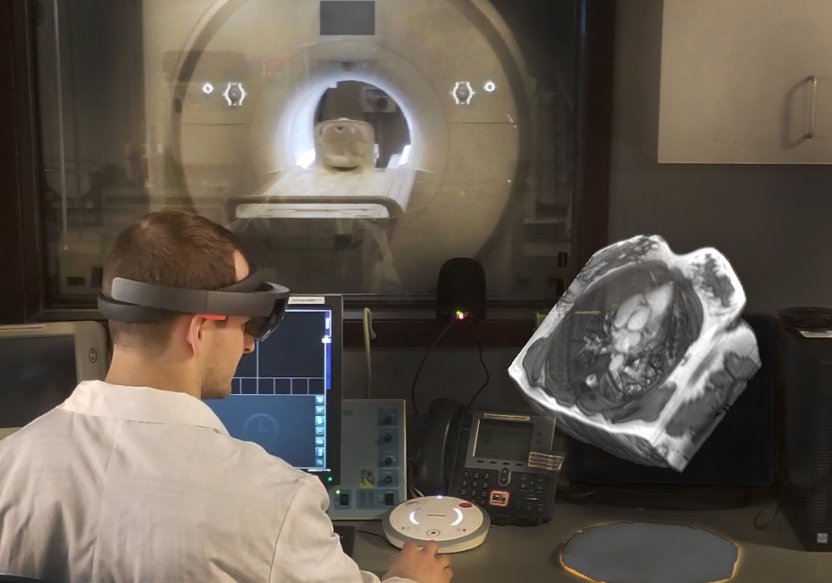
According to Microsoft and CWRU, the MRF scans contain more information for doctors and analysts to diagnose with, and they’re quicker and more comfortable for patients.
The project combines mixed-reality, machine learning, and quantum computing to solve a problem which would otherwise remain out of reach. For more information you can read the MRF white paper here.
The Next Web’s 2018 conference is just a few days away, and it’ll be
 . Find out all about our tracks here.